Home Page Dev
Glyvantis Bio has developed a model-informed cell engineering platform designed to optimise galactosylation in monoclonal antibodies and other biologics.
Precision glycoengineering for improved antibody performance
The plug-and-play technology is hardwired into the cell line to enable more consistent glycan profiles, supporting improved therapeutic function, stability and manufacturability across biologics development.
Monoclonal antibodies are a $200B+ market where potency is significantly impacted by galactosylation – a sugar modification that’s notoriously hard to control batch-to-batch. Higher galactosylation drives stronger antibody function (increased CDC, ADCC, and ADCP activity) and greater pharmacological predictability.
4x
Manufacturing variability reduction
3x
Galactose maximilsation
(addition of sugars)
80-100%
Product
enhancement*
2-Step
Plug & play
cell engineering
* Optimizes Antibody Function, Enhances Drug Stability, Reduces Immunogenicity, Controls Clinical Profile – Pharmacokinetics & Pharmacodynamics
Why Galactosylation Matters In Biologics – variability is costly
Galactosylation is a critical glycosylation process influencing the structure and function of monoclonal antibodies. In biologics development and manufacturing, it plays an important role in determining antibody efficacy, stability, immunogenicity and pharmacokinetic behaviour.
Variation in galactosylation is a recognised source of inconsistency in biologic drugs, affecting clinical performance, manufacturing reproducibility and regulatory confidence.
Galactosylation influences several critical attributes of antibody therapeutics:
30-50% clinical development failures
Inconsistent glycosylation contributes to 30-50% of late-stage clinical failures in mAb programs, where efficacy and safety depend directly on glycan profiles.
Up to $60M increased annual cost in manufacturing
Glycosylation variability can increase manufacturing costs by up to $60M per annum – directly impacting batch yield, product consistency, and regulatory timelines.
1 in 10 tech transfers fail
One in ten technology transfers fail due to glycosylation variability, at a cost of $10M per failure. This creates significant financial exposure for partners and CDMOs.
Legacy – incumbents fall short - complex, expensive, expired IP
Existing approaches (Potelligent, GlycoMAb) don’t address galactosylation, carry higher costs, and are built on expired IP – leaving a clear gap for a modern, IP-protected platform.
Level of galactosylation affects how long a drug stays in the bloodstream and how well it binds to target cells. Optimised galactysolation improves pharmacologic profile.
In monoclonal antibodies (mAbs), galactosylation affects Antibody-Dependent Cellular Cytotoxicity (CDC), functions that are crucial for efficacy of cancer and autoimmune therapies.
Problem
The challenge of glycosylation variability
Glycosylation variability remains a major challenge in monoclonal antibody manufacturing. Inconsistent glycosylation can affect product quality, comparability and development timelines, while increasing manufacturing costs and regulatory complexity in biologics production.
Potential implications include:
- Inconsistent pharmacology
- Compromised safety and efficacy profile
- Increased regulatory scrutiny
Solution
A simpler, more effective path to consistent galactosylation
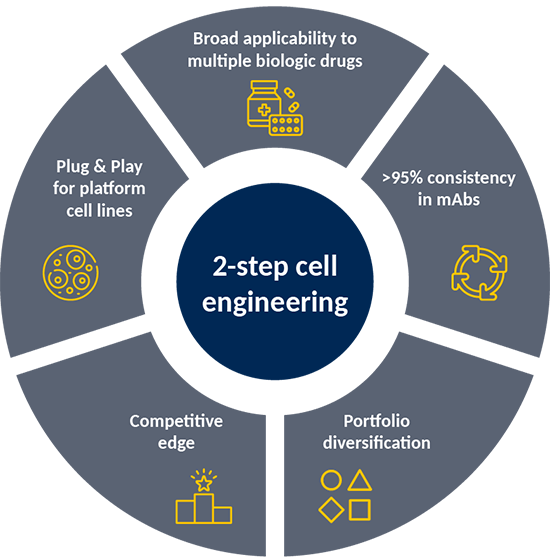
Plug-and-play two-step cell engineering technology designed to maximize galactosylation consistency in CHO cell lines used for antibody production.
Hardwired into existing CHO platforms — no new infrastructure. Technology drives homogeneous, near-complete galactosylation across mAbs, bispecifics, and ADCs.
The platform supports:
- Consistent high-level galactosylation
- Improved antibody function and stability
- Reduced variability in biologics manufacturing
- More predictable glycan profiles
Applications in biologics development and lifecycle management
Glyvantis technology is applied at the antibody cell line engineering stage, enabling use across:
- Development of new monoclonal antibody and other biologic therapeutics
- Enhancement of existing antibodies (“bio-enhanced” products)
- Lifecycle management prior to loss of exclusivity
The platform supports multiple commercial pathways, including:
- Technology licensing with cdmos
- Sales-linked royalties from pharma partners
- Internal biologics pipeline development